| |
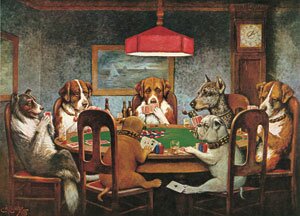 Lucky Dog! Lucky Dog!
The Art History of C.M. Coolidge?s Dogs Playing Poker
By Annette Ferrara
C.M. Coolidge is the most famous American artist you?ve never heard of, even though his paintings occupy a rarefied echelon of artworks with Edward Hopper?s Nighthawks, Grant Wood?s American Gothic, and Andy Warhol?s Campbell Soup Cans. These signature works, for better or worse, are indelibly burned into the subconscious slide library of even the most un?art historically inclined person through their incessant reproduction on all manner of pop ephemera: calendars, t?shirts, coffee mugs, the occasional advertisement. The difference with Coolidge?s most famous image and these others, however, is that Coolidge?s subjects seem to have gambling problems and, one surmises, doggy breath.
|
|
| |
Coolidge?s most famous and well?loved image of seven smoking, drinking, card?playing canine buddies, A Friend in Need, c. 1870, has been a staple in any basement rec room worth its wood paneling for over a century now, even if it?s rarely referred to by its real title. Known in the vernacular simply as Dogs Playing Poker, this slipshod misnaming of such a dog?eared work of art is, according to journalist Dan Barry, who has researched Coolidge for The New York Times, ?not unlike referring to one of Van Gogh?s self portraits as ?Guy Missing an Ear.?? More often found on thrift store walls between velvet Elvis paintings and Oriental?themed paint?by?numbers than in hallowed museums, there have been so many variations on Coolidge?s original theme?even by the artist himself?that it?s startling to think there was once an ?original? painting of gambling dogs, nevermind an artist who created it.
Cassius Marcellus Coolidge, like the bulldogs and mastiffs that populate his backroom gaming parlors, was a hustler. Nicknamed ?Cash,? Coolidge was born in upstate New York in 1844 and didn?t know a potential money?making opportunity he didn?t like. He left his family?s farm in the 1860s and restlessly bounced between careers. He tried his hand at being a druggist, a painter of street signs and house numbers, an art teacher, and a cartoonist. He wrote a comic opera about a New Jersey mosquito epidemic, founded a bank, and started a small newspaper called the Antwerp News?all before 1872. After a trip to Europe in 1873, he settled in Rochester, NY, and began the next phase of his life as a portraitist of vice?addled dogs that had penchants for games of chance. Coolidge?s first customers were cigar companies who printed copies of his dog paintings for giveaways, but his real fortune was made in 1903, when Brown & Bigelow, a ?remembrance advertising? company based in St. Paul, MN, hired him to create a series of dog paintings to adorn calendars and other products. While in the company?s employ, Coolidge created 16 variations on the Dogs Playing Poker theme, with nine of them about card?playing, and the others portraying dogs dancing, playing baseball, and testifying in court. And the rest is kitsch history.
A wry and whimsical satire on middle?class, human male entertainment, A Friend in Need is very of its time formally?Impressionist brushstrokes create a dusky atmosphere while a Winslow Homer?esque painting of sailboats hangs in the background?and in terms of historical accuracy. Not only do the cards have no corner indices, but ?Poker used to be accurately called ?the cheater?s game,? recounts Jim McManus, poker enthusiast and author of Positively Fifth Street: Murderers, Cheetahs, and Binion?s World Series of Poker. ?In A Friend in Need, the blatant cheating refers back to the early 19TH century, Mississippi riverboat days, when poker was mainly a series of opportunities to fleece the suckers.?
Aesthetic critiques of good or bad, avant?garde or kitsch aside, an original painting by Coolidge in today?s market will fetch its lucky owner a big pile of bones. ?We currently have a pair of original Coolidges up for auction, A Bold Bluff and Waterloo, that we are estimating at $30,000?$50,000,? says art historian Alan Fausel, Director of Paintings at Doyle New York who has placed the works in the auction house?s annual ?Dogs In Art? sale. ?We normally don?t deal in anthropomorphic dog portraits, but Coolidge is a master American illustrator who has created icons as important as James Montgomery Flagg [who created the popular ?Uncle Sam? image] and Norman Rockwell. Every time we hold a ?Dogs In Art? auction, the phone rings off the hook with people asking if we have ?those paintings of dogs playing poker.? We decided to comply this time.?
What is it about A Friend in Need that has caused the painting to burrow so deeply into Americans??nay, perhaps the world?s?collective schlock?image database? Well, there?s the obvious: there are dogs in the painting. For pathologically obsessed dog lovers, this might be enough. But instead of showing dogs rolling in something or sniffing each other?s hindquarters, Coolidge?s overly anthropomorphized canines are burning the midnight oil?it?s after 1:00 am according to the grandfather clock?enjoying some smokes, imbibing ?hair of the dog? cocktails, and snarking aces off the gaming felt with a back paw. McManus has a different take. ?Its main appeal is how funny it is. Poker?s a fairly cerebral activity, so the idea of dogs playing is patently absurd. And contemporary artists love its kitsch, which has a lot to do with the fact that it?s so God damn bad as a painting.?
|